open the door of possibility and vulnerability with some simple exercises
Welcome! If you saw the word prompt here and are thinking about entering it into some kind of chatbot, whoa there buddy, these prompts are for humans only! If you are new to this publication and my work, I’m ai-sober. Meaning I do not, use any generative-ai tools or LLMs in any of my work. Zero! Zip! Nada! And I also don’t consent to having my work used with them. Read my full ai policy here.
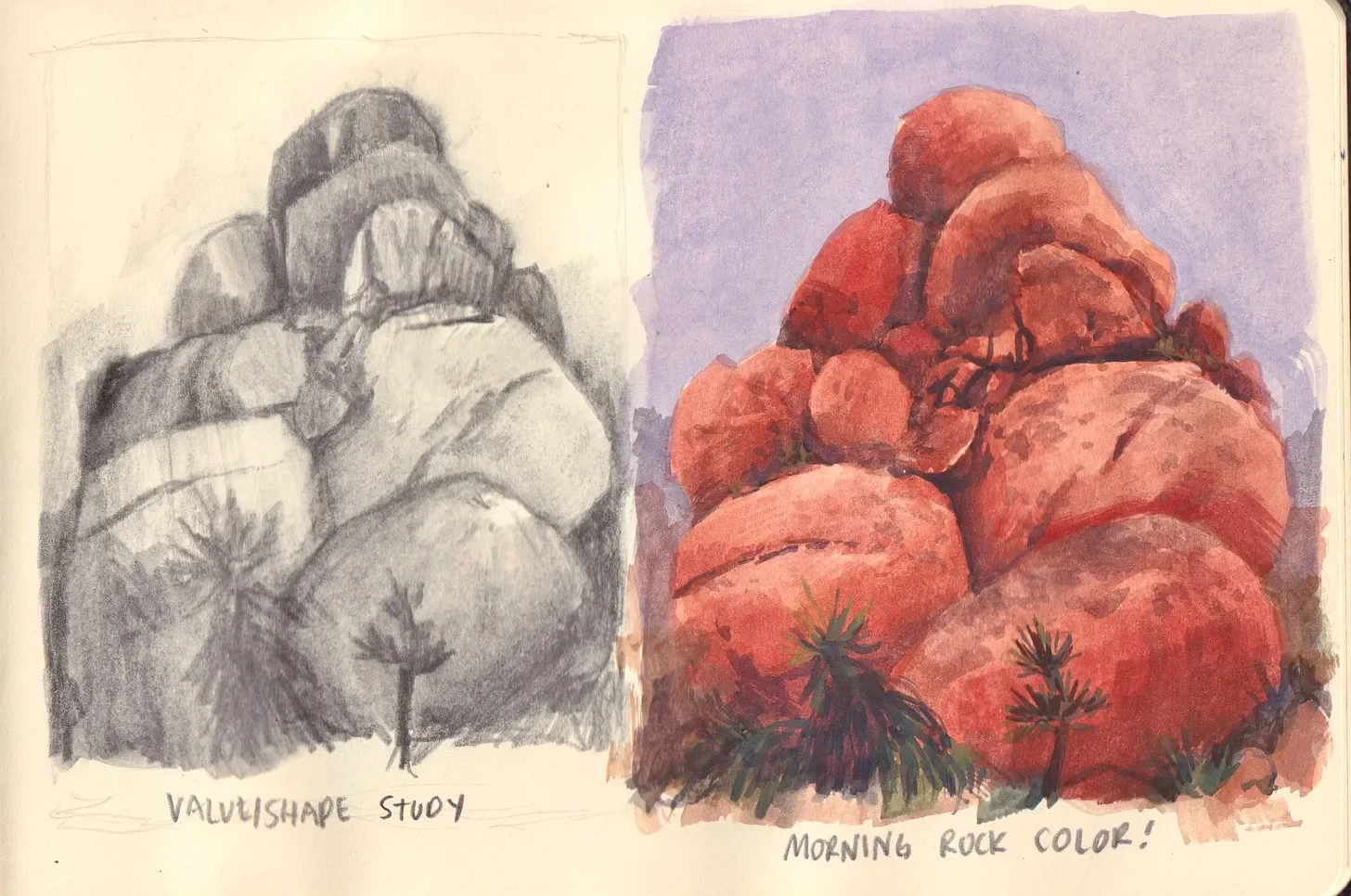
a sketchbook spread studying the rock color, shapes, and values near my campsite in Joshua Tree National Park.
Next month, just after the start of spring, I am teaching a class on drawing and starting a sketchbook. The class is called Start Drawing! Building a Compassionate Sketchbook Practice. In it I’ll be sharing tangible skills, wisdom on drawing as an intuitive craft, and most importantly, how to keep going when you feel discouraged, challenged, or disappointed.
The class starts on March 28th and will last for 4 weeks, with three weeks of instruction and one guided practice break — to test out our skills and find strategies to adapt when things go wrong.
Why am I teaching this class?
This class had the largest number of waitlist signups. I am running my business this year democratically, building out classes fully once I have demand from prospective students. You can see the waitlists here.
Drawing is something I see my adult students struggle with constantly. When a painting or digital art student asks me “how can I improve my work and build more confidence?” I always say “start drawing!” and they usually shudder, which is discouraging! I can see the depth of intimidation that a drawing practice presents for them.
Our western education system fundamentally breaks our ability to draw. It’s something we have to relearn.
In school, we learn how to memorize, replicate, and create in rigid frameworks. We have standardized tests, assignments with clear outcomes, and rubrics that determine Quality. Even in high school art classes, we are graded on how well we made our work. This invites the inner critic to get loud, and for us to pickup bad advice or feedback from a trusted adult that makes us give up on drawing altogether.
When I was a kid, I couldn’t stop drawing. I didn’t care how good the drawings were. In college everything changed because a scholarship was on the line.
Despite going to art school I rarely kept a sketchbook. The 9” x 6” notebook I carried around with me throughout college was full of writing, critique notes, to-do lists, and the occasional drawing. 1 out of every 50 pages had a sketch of some kind. We were graded as students on our “research binders” each semester, not our cultivation of craft. I did not feel safe experimenting or failing in an environment where my creativity was graded on a rubric.
It was weirdly unsafe to make representational work in the Painting department after sophomore year. The egos and hazing behavior of fellow students made me focus on doing what was safe. Everything needed to be backed up by theory, not craft practice. The critique rooms focused on research rigor and concept, as a way to unify artists working in sculpture, performance, abstraction, and realism under one grade-able umbrella.
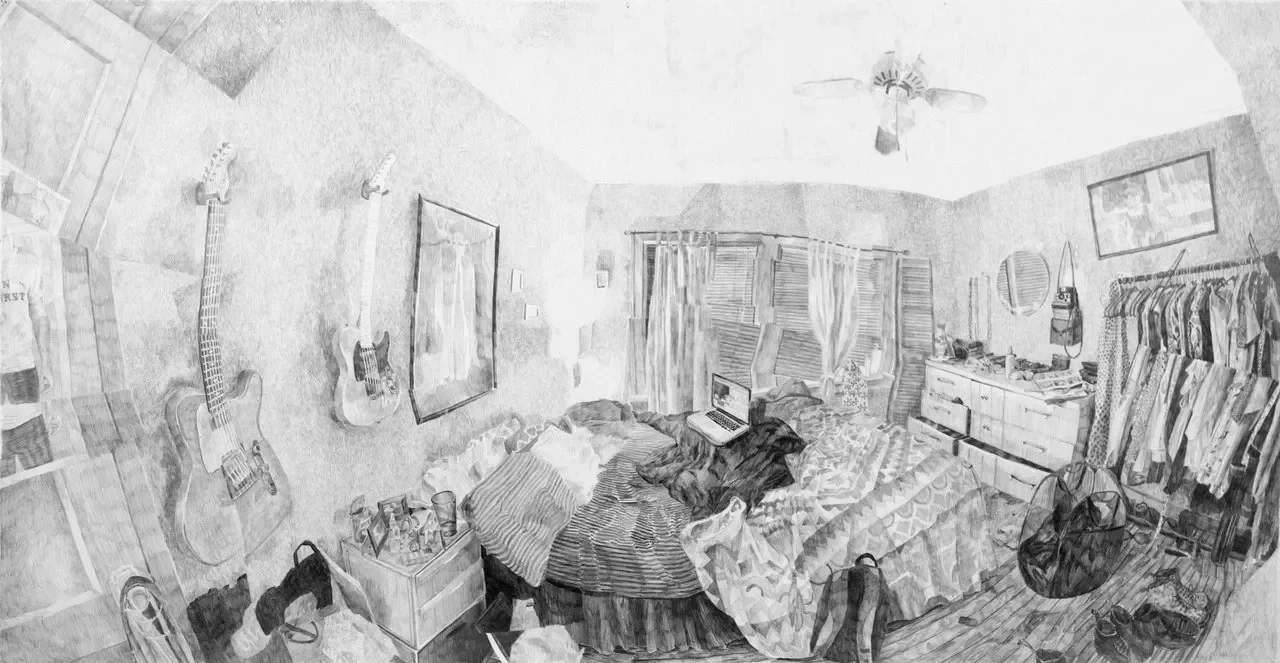
a giant pencil drawing from my undergrad thesis of my college bedroom, (this was about 40” wide!) inspired by the photo collage work of David Hockney and his writings on identity and perception
I studied what success looked like, based on the grading system, and did that.
I dove into research. I had to be prepared to defend my work every few weeks and make sure that my experiments looked good enough. My sense of experimentation happened in writing, inspiring me to double major in Creative Writing, but dropped the pursuit due to cost. Every single painting or drawing was started digitally, in Photoshop —a space with an undo button — that way I wasn’t wasting expensive supplies.
My pieces were based off photographs I took or virtual sets I built so I could reliably control and produce artwork of Quality in the eyes of my professors.Going to an expensive private art school on scholarships meant there wasn’t room for error or failure. Spending my nights and weekends working a job to pay for what loans didn’t cover also meant I never made real time to sketch outside of life drawing sessions.
That’s probably why I retook figure drawing three times. I wanted to buy time for observing and learning, to remember how drawing worked.
My first real sketchbook came out of a necessity in adulthood — in 2023, 10 years after graduating with my BFA, to figure out who was the artist underneath all the research and perfectionism. It was my deep path as both a recovering academic and former corporate employee.
What did it mean to actually follow my intuition, to play with materials, and to figure out what kind of artist I really wanted to be?
That’s where sketchbooking came in. I finally had a container to fail in. A place where I could flounder around and follow my intuition, drawing whatever interested me, and experimenting with what kind of work I might wanna make for others. The most important discovery was that I was absolutely obsessed with the land I was exploring.
In 2023, I was having some of the worst symptoms of Long COVID, tachycardia episodes, lungs that felt like they were being stabbed constantly with needles, depression, and chronic fatigue. The only thing that was helping was hiking slowly. Wandering on mostly flat paths with my friends or my spouse. Sitting often to rest, observe, and sketch.
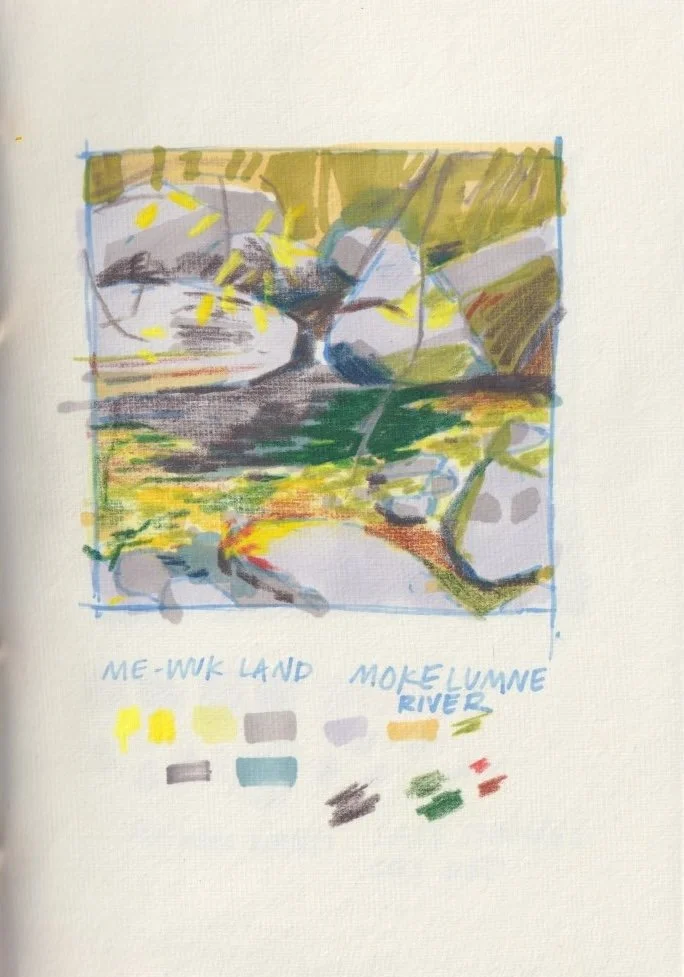
one sketch from my 2023 sketchbook where I realized what I really cared about was adventure art!
Through this process, my health started to improve dramatically. Coming back to making art, and using the process to write a love letter to these gorgeous open spaces helping me heal was magic. I wanted to be an adventure artist. I would make pieces based on my observations of California, become an amateur botanist, go feral, and spend as much time outside as possible.
My body was responding positively to this work, so I knew I had to trust it as my guide.
As my Long COVID symptoms started to improve, I was filling sketchbooks and finding my voice. I was also failing, all the time, and finding new routes — through techniques of self-compassion — to keep going.
I also quit my job and started teaching independently at the end of that year. With no institutional backing and complete freedom, the idea of retreats kept coming up for me. How can I make the classroom into a retreat? How can I undo the damage done by traditional models of education? How could I better support my students in the ways that I needed support in the past?
Sketching became a space to experiment, fail and find myself, and now I feel ready to guide others on this journey.
Let’s get warmed up to the idea of drawing with this month’s creative prompts.
Even if you can’t take the class, I want you to try and start drawing this year. It’s the year of the analog bag right? We gotta put the supplies we carry to use!
I took inspiration for these prompts from the themes in the minor arcana of the tarot1. These are general themes that any artist should be able to get something out of. The following are journaling and drawing prompts that should help you work through blocks getting in your way.
I’d love to hear from you in an email or comment if any of these practices helped!
Emotions- art with feeling
When I think of art with feeling, I remember seeing Octavia E. Butler’s journals2 at an exhibition at OMCA in 2022. One of them said “make people FEEL, FEEL, FEEL!” and that truly encapsulates what the purpose of art is. It’s a reciprocal exchange of deep feeling from one big feeler to the audience.
My sketchbooking practice became a really deep way of feeling into my love for and desire to honor the landscape of Northern California. So many of us are disconnected from the world around us, nature, and its beauty. Think about what you want others to feel deeply about.
I want you to make a list of what you love deeply.
First, think big (community, people, experiences, places, etc.)
then small (objects, supplies, mementos, good rocks, the sound of frogs in spring, etc)
Now I want you to do a hard thing! I want you to try and draw these very things you love.
If you have aphantasia3 or struggle to draw from your mind only, build a mood board of images and use them as references. I really like using Unsplash for human-made images that are free to use, and putting them all on a Notion board. I also enjoy using Pinterest for this, but make sure you turn off the ai images first.4
Often when we are confronted with the assignment to draw something we hold tenderly, our brains make up all kinds of reasons why the drawing is “not good” or “not correct.” The goal here is to simply try first, be okay with not being good at it, and be willing to adjust our expectations to reality.
In order to combat self-criticism, I want you to either pull any tarot card in the cups suit that resonates with you and/or journal about a compassionate archetype to guide you through the difficulty of this process. If neither of those feel resonant, write a small mini-manifesto for yourself on why trying hard things when no one is watching is important to you.
Think of this as a gentle way to feel into the uncertainty and discomfort that fumbling or embracing the wobble of art invites for us.
want 1-on-1 support with drawing?
Resource - what do we have on hand
Spring is upon us, and so too is the annual practice of clearing and cleaning. We are talking about having a studio-clean-out session on the Persistent Bloom Discord next month. Maybe you should join us!
Start by going through your art supplies. If you’re reading this newsletter you probably have some kind of creative supply in your home. Maybe its tucked away in a box in a closet from when you were a kid or from college. Allow yourself time to sort through them.
If you have a tarot deck, pull any card from the Pentacles suit and journal about it. Consider writing on how art making is a resource for you. Try to flip the idea that you are using or wasting supplies. Write down what you gain from the action of making.
Once you have your supplies and you do a little reflection to loosen up around them, get out some copy paper, scrap paper, or a sketchbook and try them out. See what happens when you use them, misuse them, work with them like a kid would. Set a timer for 30 minutes and let yourself get lost in the play.
After this session, reflect with the following questions:
How did each of the supplies feel:
Did it bring up any emotions for me?
Did it feel pleasurable to use this supply over another?
Why did I get this supply in the first place?
What might I want to make with it?
What types of inspiration should I start to collect in order to keep this practice going?
What things am I good at drawing? What do I want to learn to draw?
If you enjoyed this dispatch about drawing, but still find it intimidating, you should read this article by Drawing Thought about how the practice helps us to deal with not knowing, needing to adjust, and being wrong:
The rest of the creative prompts (on passion and ideas!) for this month will live behind the paywall for the folks supporting me monthly on Substack at the patron level. As a reminder, I don’t take on sponsors through this space or YouTube, which means that I am 100% viewer/reader supported.
Until the next dispatch, stay creative and find your own ways to persistently bloom.
-Mel
Not into the tarot? Ignore that part of the prompt!
they are seriously so good https://kmalexander.com/2021/06/22/octavia-e-butlers-notes-to-self/
the inability to visualize images in your mind
if you login to Pinterest on a computer, go to your profile, click the lil gear, and find the “gen ai interests” section. turn everything off!!!!
