my accidental personal curriculum that could positively impact you too!
a collage that says “the books that shaped my year”
This year felt like liquid, like a sea chaos, but books were my anchor. I never had the intention of building a “personal curriculum” but in a way, looking back that is absolutely what emerged in four core topics: Ecology/Nature, Creativity, Tech, and Society.
The following titles I borrowed from my local library and, on occasion, purchased at a local bookstore. I recommend getting them that way, or through linking your library card(s) to the app Libby and experiencing them on an E-Reader.
The links I put below are to Bookshop.org and are affiliate links, meaning if you click through them to buy something, I’d make a small commission. If you’re like “boo, hiss” about this, bro, I don’t take any sponsorships, and this is the only affiliate program I participate in. If you login to Bookshop.org when you make a purchase, the profit share can also be shared in part, to your favorite local bookstore instead of Amazon.
This year all of these picks were just guided by curiosity and I really recommend that if you want to read more and scroll less in the new year, let curiosity be your guide.
Audiobooks are just as valid as physical or digital books. If you feel like you’re overwhelmed by the sea of hot takes and short form content, reading a book of someone’s planned, articulated, and well-edited thoughts will feel so nourishing! Especially if you do it with a nice cup of tea and a craft project (have I mentioned audiobooks rule?!)
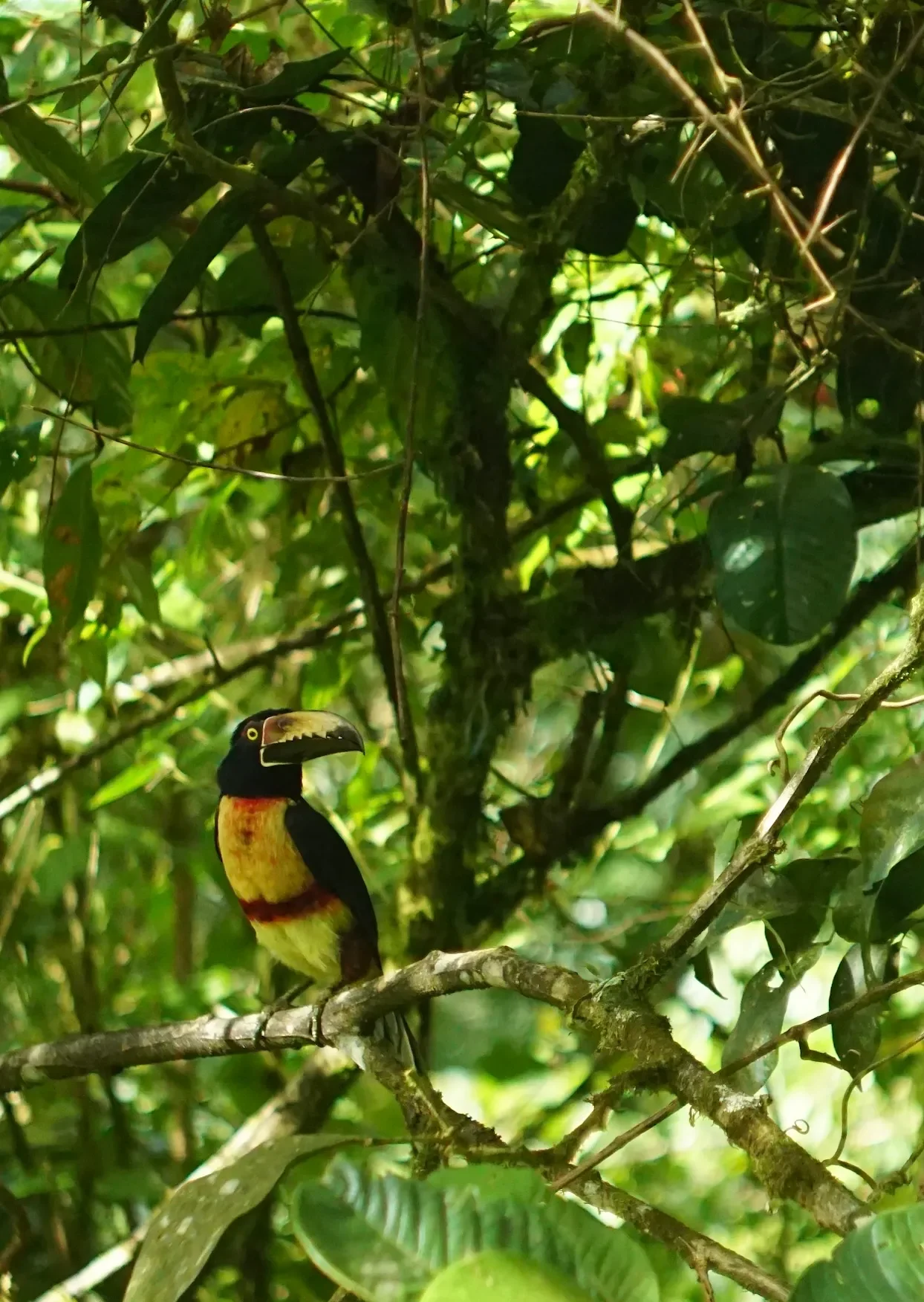
photo of an Aracari sitting on a tree branch near Nuevo Arenal, Costa Rica. Lots of bird and bromeliad photos coming to my reference library this month!
Before I get into it I want to mention a few housekeeping things:
I’m currently working on editing a self-directed version of my Beginner Watercolor & Gouache class. It should be out at the very beginning of 2026 and it will be $109. See the button below to join the waitlist!
I’ll be teaching an online physical-to-digital collage workshop at the end of January/early February as a collaboration with my friend Kim of Oinopo Studio. Class will be $79 as one half of our 4-part digital design workshop that centers human creativity and reminds you that you only think you’re bad at graphic design. We’re doing exclusive bundle discounts if you sign up for all 4 sessions too!
My long-awaited Building a Compassionate Sketchbook Practice online class will start February 1st and tickets will go on sale January 19th! More info on all upcoming classes is on this page, along with waitlist links here:
Week zero of The Hikers Way is no longer free when signing up for this newsletter. Instead, it’s been improved and transformed into Cycle Zero which is just $27. Everyone who previously got Week Zero still has access. If you do Cycle Zero and like it, you get a discount on the other three cycles/weeks in the Hikers Way!
There will also be a HUGE photo-reference drop for paid subscribers at the end of the month of the photos from my trip to Costa Rica you can read more about the reference library benefit for my paid supporters in this post.
I finished the Youtube video version of my AI sobriety essay that you can watch here complete with bird sounds and visuals from Costa Rica!
Okay, let’s dive in.
I read 35 books this year! Most of them, digital editions from the library or audiobooks. Since I started knitting last October, audiobooks have become my favorite way to weave knowledge, depth of understanding, and story into fabrics I can wear or gift. If you wanna start a knitting practice, you should read my piece about it I wrote earlier this year.
I broke these books down by category and they are in no particular order. Really, the ones at the top are just what came to mind first, if you wanna read into that, go ahead! There are several I didn’t complete, and several that frustrated me but they got my nose in a book!
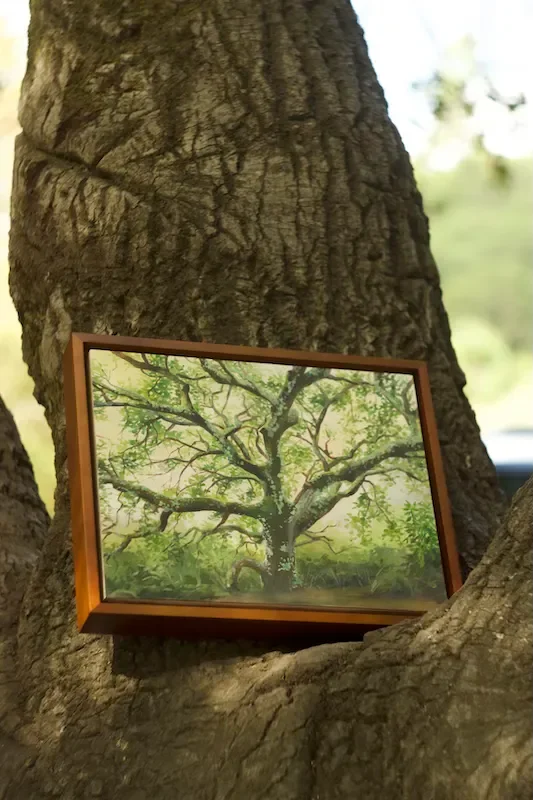
Lichen Live Oak framed Oil painting sitting between the branches of a Coast Live oak at Reinhardt Regional Redwood Park. My favorite studio painting of nature of the year, by far. This piece is still available!
Ecology/Nature
Everything in this category was central to my research practice for my full body of work: my paintings, creative retreats, and my pod-class The Hikers Way.
How to Love a Forest by Ethan Tapper
This book was sitting on the “new” shelf at my local library and I was immediately interested in reading the words of a Forester. One of our best friends has spent his career in Forestry and I have always wondered what the worldview is like of other folks in the field. This book had me sobbing in the first few chapters and I couldn’t put it down. I learned about the importance of snags, my muse of the year, and wolf trees. To really hit the point home on its magic, I’ll share a quote (emphasis my own) that still makes me misty-eyed.
“The man was learning that he was connected to everything and to everyone on earth through the responsibility he took for the present and the legacies he left for the future. Rather than letting legacies of the past crush him, the man draped himself with them. The weight of the burning world settling on his shoulders. Day by day he began to build something beautiful of his brief life. Day by day he did what he could to become like the wolf tree: something emergent, a beacon in a world of shadows.”
Forest Bathing by Dr. Qing Li
This book was an incredible retreat into the science behind much of what I was intuiting about nature time as a healing practice. Studies that Dr. Li performed showcased how time in nature lowers stress hormones, how certain smells in the forest (like peat, dirt, and particular varieties of cypress) help alleviate anxiety. My favorite quote:
“Make sure you have left your phone and camera behind. You are going to be walking aimlessly and slowly. You don’t need any devices. Let your body be your guide. Listen to where it wants to take you. Follow your nose. And take your time.”
The Nature Fix by Florence Williams
I read this as a follow-up to Forest Bathing and was not disappointed! Williams gets more into the aspects of how our creativity is bound up in time spent in nature. How the natural world makes us more curious and open creatures (deeply needed to make art!) It also put a lot more scientific studies in context for how nature time promotes our holistic wellbeing. A worthwhile read for a nature nerd.
Gathering Moss by Robin Wall Kimmerer
I genuinely believe that if you read this book, you have to listen to the audiobook too! Kimmerer’s narration is truly brilliant. Mosses and Lichen have become a deep fascination for me living in an area with so much access to temperate rainforests. This went deep into how they live, spread, their curious relationship to gender, and the ways folks sometimes mistreat them. Plus, this book gave me my favorite quip about AI all year, Robin’s neighbor, a dairy farmer, refers to waiting on the AI truck, and when the neighbor corrects Robin’s assumption about an intelligence truck the neighbor goes “no, no, artificial insemination!” I cackled aloud on a plane.
Finding the Mother Tree by Suzanne Simard
Another book about forestry, climate change, and resilience. Plus, queer romance and overcoming a male-dominated field full of bros trying to undermine your research, I couldn’t put this one down either. Simard led studies that proved how companion plants share nutrients with one another, effectively shutting down arguments for clearcutting practices in Forestry. Plus, trees talk to each other through mushrooms and protect their offspring!?! Hell yeah.
A Philosophy of Walking by Frederic Gros
The beginning of this book was excellent! The second half was a DNF for me. I started reading it after I injured my spine and was mostly bedridden for a month in pain, on ice, struggling to walk. It helped me realize I was approaching hiking all wrong, from the perspective of how to hit goals and track everything as a method for measuring quality. I loved the idea Gros puts forth that “Walking is not a sport.” and the way he embraces slowness was not lost on me. Had I read this before the hike where I hurt myself, the fate of my year might have been wildly different!
Drive Your Plow Over the Bones of the Dead by Olga Tokarczuk
I’ve been wanting to read more stories by Polish authors to get more in touch with the folklore of my ancestors. So when my partner heard about Tokarczuk winning the Nobel Price in Literature, he started reading this and immediately insisted that I read it too. He was right! The main character is very much a Baba Yaga archetype living deep in the wilderness with a set of odd neighbors. Her obsession with astrology and the local wildlife leads her to uncommon conclusions to solve mysterious murders that keep occurring in the woods. It’s a great read, and the audiobook narrator has the perfect Eastern European accent to sound like it’s one of my aunts reading to me.
Wilderness Essays by John Muir
In June, my partner and I spent the Solstice in the Eastern Sierra, not far from Mono Pass and the very locations where Muir wrote these essays from. They read like poetry and were our favorite way to spend time by the campfire, reflecting on all the epic beauty we witnessed the day before. Plus, Muir was a wild dude, using rocks to hit ice off glacial granite and traveling without more than tea and bread in his backpack. True hobbit behavior.
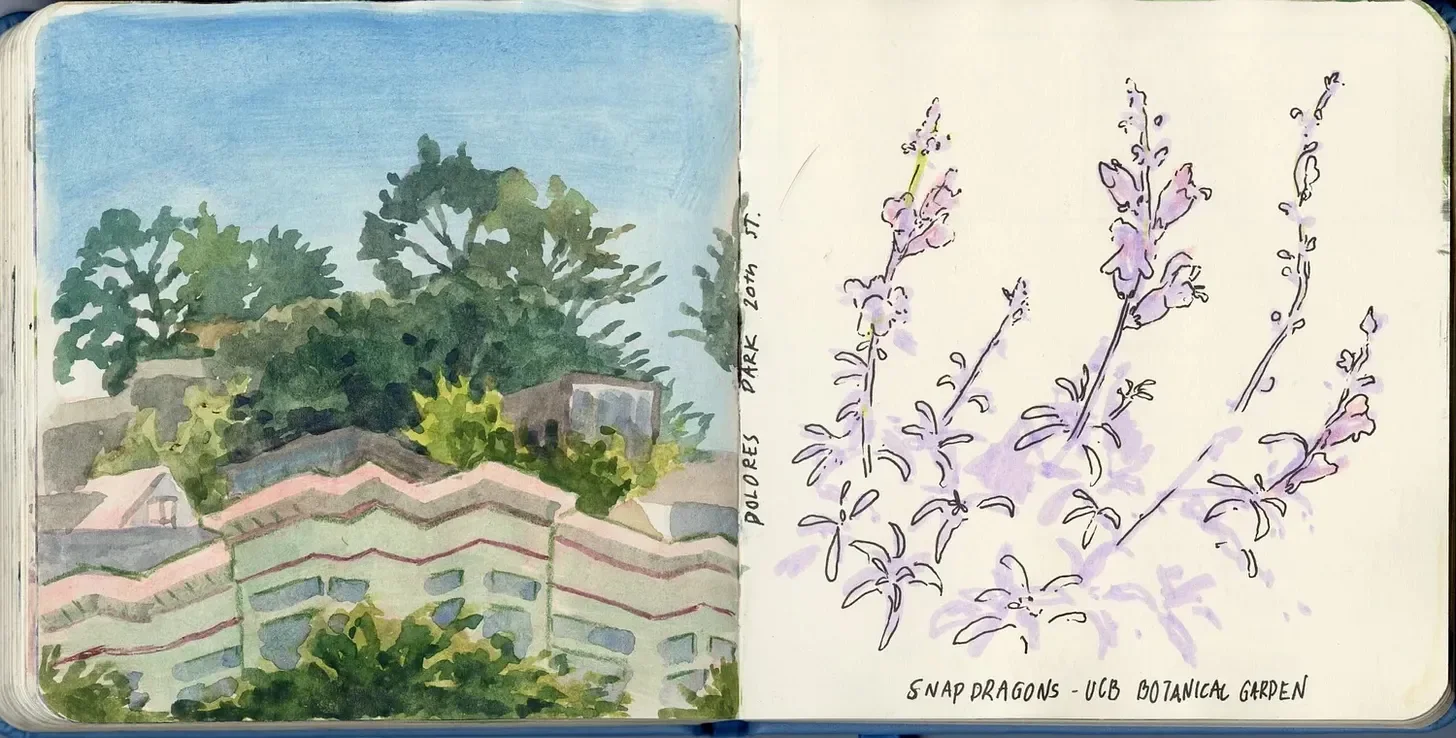
Sketchbook spread of the view from Dolores Park in San Francisco and a quick illustration of the Snapdragons in the UC Berkeley Botanical Garden. I spent the year scanning and uploading my Sketchbook pages to my website so people can browse them and savor them slowly!
Creativity
As a creative educator, these books inspired and supported my practice of uplifting the creativity of others all year!
Art & Fear by David Bayles and Ted Orland
Art & Fear is my favorite book about creative craft. I read it for the first time in 2007, again in 2012, and since 2023 it has become a once yearly ritual to reread. All of my ideas around persistence and staying true to your artistic voice live in this book. It’s small, tangible, and practical while being one of the most soothing reads. If you’ve taken a class with me, I’ve probably read it to you. If you went to art school, had a bad time, and need to be reminded of what actually matters, this book is for you.
How to Not Always Be Working by Cody Cook Parrott
This book was the reminder I needed in the early part of 2025 to try and shut off endless work brain, a symptom of being self-employed. Cody’s work and teaching practice have become a favorite of mine to watch and follow. It’s a great primer for anyone who has been conned into monetizing all their hobbies, to recognize that you are allowed to take breaks, and to tiptoe into tech sobriety.
Portrait of an Artist: A Biography of Georgie O’Keeffe by Laurie Lisle
While this book is out of print, it’s worth searching for at your local used bookstore. I found a copy with a decaying cover at Dog Eared Books in San Francisco for $6 and flipped right to the section about O’Keeffe’s retreat to Taos and knew I had to have it. I’ll admit, I skipped the whole first section about the artist’s life in New York but found the stories of her life in New Mexico to be super evocative and relatable. She went absolutely feral, shipped crates of bones back east, would spend hours in nature observing the light, and coveted — to the point of even stealing from friends — really good rocks. O’Keeffe’s work and life had a relatable kind of queerness to it that kept me reading and deepening my love of her work till the end.
Your Art Will Save Your Life by Beth Pickens
Written after the 2016 election, this was the book I needed this year when I found myself wondering if the act of making art itself even mattered under authoritarian capitalism. Pickens centers joy, community, and the ways that art itself is an act of resistance. She also helped me shift my media diet (Democracy Now, only on Fridays) around the news and keeping up with what’s going on. It is really easy for me to be a doomer, this small book is an anti-doomer manifesto that will help you recognize the importance of your creativity.
The Artists’ Way by Julia Cameron
I wrote an entire essay AND made a YouTube video about this book with my opinions going in depth. The quick take version is that this book was written in 1991 and has a lot of outdated perspectives. The root of what Cameron teaches, to allow space for your creative recovery through these exercises, is great! I just think her method is too rigid and some of the language pushed me away rather than pulling me deeper into my creative practice. Which is why I built an alternative!
Syllabus by Lynda Berry
I finished reading this one yesterday and if The Artists Way gave you the ick for some reason but you want a semester’s long (15+ week) structure for building a writing/drawing practice, this book is a must read. Berry is so funny and I love the fact that this books rides the line between graphic novel, pedagogical philosophy, and celebration of the weird in human creativity. She encourages her students to work in cheap composition notebooks and on index cards using materials that aren’t precious on purpose. I am going to be buying my own copy, it was just too good!
Making Music: 74 Creative Strategies for Electronic Music Producers by Dennis DeSantis (free from Ableton!)
Because I started making music again this year, this book has become a fun place to dive into and play with the prompts. I’ve never read it from cover-to-cover but occasionally I’ll pull it off the shelf and turn to something that my partner has marked off as particularly important. The section at the start Problems of Beginning is what I turn to the most. I love that DeSantis makes some references to drawing and a lot of the techniques suggested helped me build the rituals around my creative practices.
Color & Light by James Gurney
This book is a must have for any painter focused on craft and capturing light from life. James Gurney is the compassionate incredibly skilled art dad I needed to find on the internet when I came back to my creative practice in 2022. I had completely stopped painting (thanks, depression!) and found myself really stuck with the negative associations around it after splitting from my mentor. I kept hearing my old professors in my head from art school, especially the bad ones. This book completely helped me re-learn the techniques and tools from a perspective that felt fresh, clear, and independent from concept. Now I use it regularly in sessions with my tutoring students.Gurney is one of my favorite people to watch on YouTube and read right here on Substack. He inspired the video I made about my Art School experience that brought a lot of you here.
The Artist’s Guide to Sketching by James Gurney and Thomas Kinkaid
Another essential skill-focused book for aspiring adventure artists! And yes, the co-author is that Thomas Kinkaid! This book is a gorgeous kit builder for anyone with ambitions to start a sketchbook practice. My favorite section is one I return to with students all the time, Achieving Accuracy! I promise your jaw will drop when you see all the gorgeous examples peppered throughout. A serious reference gem for any artist.
The Gift: Creativity and the Artist in the Modern World by Lewis Hyde
I started reading this one after watching CJ the X talk about it in a video and it was definitely thought provoking. As I read it, I imagined a world where all the art I make and work I do could be a part of a gift economy, as I see the work I make through knitting and music as gifts, rather than ways to support my life and its super freeing. I didn’t end up finishing the book because my loan expired, but after getting about halfway through, it made me open myself up to bartering and trade as options with others this year. This is one I plan to revisit once I have moved out of a high cost-of-living area where the shadow of late-stage capitalism determines a lot of what I do.
What Art Does: An Unfinished Theory by Brian Eno and Bette Adriaanse
I love this little book! Brian Eno is an absolute treasure, and the drawings by Bette Adriaanse are amazing. I picked this up after watching the incredible interview Eno did with Apple Music’ Zane Lowe. This book is honestly such a poignant reminder of what makes human art so interesting and wonderful in the first place. It’s a quick read, heartwarming, and it will join Art & Fear as a yearly book to return to.
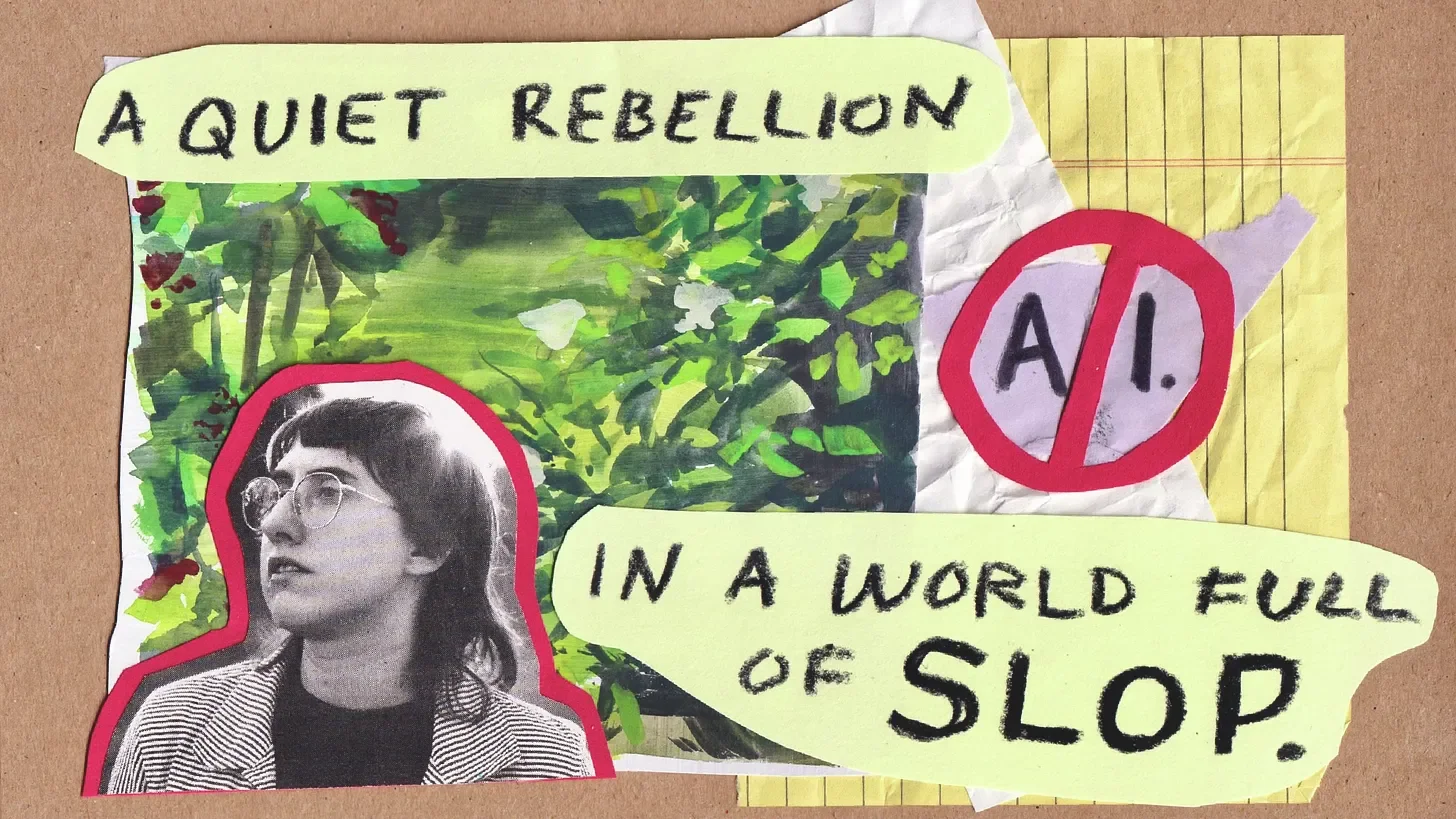
a chumbnail I made for my most recent Youtube video and essay on ai sobriety. It says “a quiet rebellion in a world full of slop”
Tech Culture
Zen and the Art of Motorcycle Maintenance by Robert Prisig
This book reads like fiction, but is really philosophy. Most of my best ideas come from long drives on windy mountain roads, much like Prisig’s mind as it weaves memory, narrative, and the concept of Quality throughout the pages. This book is an adventure, bringing up my own past perceptions of Academia, the importance for humans to have clear, opaque and close relationships to their machines, and the ways that mental health has been demonized in our society. It has so much to return to. Our copy is covered with marginalia from both me and my partner on every subsequent reread. I can’t really explain this book, just invite you to experience it and discuss it with me, as Prisig would likely prefer.
Blood in the Machine by Brian Merchant
I kept meaning to read this book, borrowing it from the library several times but once I sat down with a difficult sweater pattern to knit and the audiobook, I was absolutely glued to the story. You’ll learn about the real history of The Luddites, the folks in their periphery (Mary Shelley and Lord Byron!) and see the very specific ways the current AI crisis is a direct mirror of early 1800s England. You’ll never look at the word innovation or entrepreneur the same way (they’ll give you the ick by the end I promise!) and if you take up knitting as a radical act of rebellion and solidarity, don’t say I didn’t warn you!
Your Attention is Sacred Except on Social Media by Amelia Hruby
This year I got really into Amelia Hruby’s podcast Off The Grid: Leaving Social Media and found a real balm in Hruby’s voice, perspectives, and guests. I felt unintentionally gaslit by the over culture when I left Instagram in January and when I took my social media fast in September, I bought this book and listened to most of it while knitting instead of scrolling Tiktok. In it, I found so many of the affirmations and perspectives I needed to finally let go of needing to perform in the carnival of short form content. I have also been returning to this book as YouTube continues to frustrate and disappoint me and plan to structure my year in a way that isn’t driven by stats and dashboards.
Amusing Ourselves to Death by Neil Postman
I started reading this after watching a v brilliant struthless video about “Your Brain on AI” and holy crap this was a knockout suggestion by Cam. I learned about a professor who was recommending “e-media fasts” back in 2006, how television, and subsequently social media, and short-circuited any meaningful discourse. This book made me link text-based short form posts to the telegraph, helped me understand how decontextualization of everything makes communication often really ineffective, and that we are truly in a moment where we need to actively turn away from the encouragement to watch continuously. I’m certain I will be returning to all my highlights in this book for a longer essay at some point next year. It’s a short read that will make you call your friends and take a serious inventory of your screen time.
Empire of AI by Karen Hao
OOOF. I have to say that this book is both a masterpiece and it will make you really depressed about the state of tech culture. Hao is a brilliant writer and has so much experience having had an inside view into Open AI while a writer at the MIT Technology Review. She brilliantly showcases each layer of the fucked up strata that makes up the core AI companies, their worldview, and why I feel like living in the Bay Area is no longer for me. If you need a well-researched primer on how exactly these tech bros are trying to colonize the world through their delusional pursuit for super intelligence, this is it.
The AI Con by Emily M. Bender & Alex Hanna
If you need to cackle while reading about current AI culture, this critique by Emily M. Bender and Alex Hanna is a delight. Traveling while listening to the audiobook is recommended. I took a wealth of notes and found that this book, while similar to Empire of AI gave me a lot of hope in how it is framed. One of my favorite quotes to takeaway was
“If they couldn’t be bothered to write this, why should we be bothered to read it?”
and that really sums up my attitude around the slew of generated content that is everywhere. It was an affirming read that helped me realize that as a queer, disabled member of the Polish diaspora, it’s not okay to normalize technological pursuits that center eugenics and probability over ethics and humanity.
Society
On Tyranny by Timothy Snyder
This book had to be read after Snyder fled the US at the beginning of the year. His words in it are so vital and important. Stark reminders of how we should behave and show up in this time of rising authoritarianism! I love his reminder that
“Life is political, not because the world cares about how you feel, but because the world reacts to what you do.”
I have been working to honor my Polish ancestors (many of whom are mentioned in this book) by continuing to stand out and speak up. I would so rather folks in alignment with this authoritarian regime unsubscribe from this newsletter and never support my work than pretend politics doesn’t matter right now. I won’t obey in advance, and neither should you.
“Get outside. Put your body in unfamiliar places with unfamiliar people. Make new friends and march with them.”
Parable of the Sower by Octavia E. Butler (novel AND graphic novel)
My favorite fiction book of all time. The work of Octavia E. Butler resonates like the perfect sound, dialed in on an instrument to make you cry with poignancy. I reread this book, starting in January and then when the LA Fires broke out, I felt compelled to design a zine inspired by the main character, Lauren Olamina’s go bag. The book gets more and more evocative each time I return to it, and it is the place where the seed of my obsession with Humboldt County and building a Retreat Center stems from. The Graphic Novel adaptation was a great way to experience the book in an entirely new way. I drank it in one afternoon and sobbed at the imagery. The power of art made by human’s whose goal it is to make us FEEL is truly what shapes change.
Simplicity by Mattie Lubchansky (graphic novel)
A graphic novel that came via a recommendation on the Persistent Bloom Discord Server and whoa did I love this. Similarly to the sequel of Parable of the Sower, when small communities form and break off from authoritarian dystopian governments, they are often met with violence. This one was much more lighthearted, surprising, funny, queer, and really imaginative. I loved the art, the story, and the calamity of it all, including the hilarity of gender identity confusion in an automated doctor appointment.
Loving Corrections by adrienne maree brown
If you’ve ever wondered who is the most central author to my worldview, it’s adrienne. Their book Emergent Strategybuilt the compass for my life and worldview after walking away from the art world and my former mentor.
“Emergent Strategy began my exploration of looking to the natural world, including our own human nature, to understand how we can be in better relationship with each other as we shape the changes of our time.
If we learn the lessons of emergent strategy, we understand that change is constant, and one element of our human work is to apply our reasoning capacity to the changes we must make together, in ways that are life supporting. If we understand that we cannot cancel other living beings from the world, then how do we find dignified ways of being in communities that face, address, and evolve beyond harmful patterns?”
The ideas they write about merge ecology, technology, culture, and hope, all from the perspective of someone working in the lineage of Octavia Butler. What I loved about Loving Corrections was that this book is the antidote to cancel culture. It helps vision a space where we call people in, learn to communicate better, and find ways to stop policing each other.
“When enough of us relinquish injustices that only pretend to benefit us, we tip society toward justice.”
A Peoples History of the United States by Howard Zinn
This one was core to my research for my video essay on why your friends are leaving Instagram and helped me link the history of the Robber Barons if the 1890s (the last time we had a wealth gap of this scale in the US) and the ways in which their greed broke ground for labor movements, unions, and the rights we take for granted today. I plan to return to this book in parts over the next several years, I don’t recommend sitting and consuming it all in one big chunk, unless your mental health is far better than mine. But take the time to sit with and process the realities about US History that Zinn shares. My partner read this in high school, and it completely changed his worldview. I think it should be required reading for all people living in the United States, but accepting the realities presented within it is the work of a lifetime.
How to Prepare for Climate Change by David Pogue
This tome is a great reference book for addressing climate anxiety and giving you practical strategies to… prepare. It made me a bit of a prepper, but living in a state with earthquakes, landslides, atmospheric rivers, and wildfires, I’m glad I have learned these core skills to support my community. This book was a big reference for me in making sure the Go Bag Zine had adequate and correct information.
Brave New World by Aldous Huxley
Not your typical vacation read, I finished this one recently while traveling and deciding on where I want to relocate in the new year. I had to start reading it because of Neil Postman’s constant reference to it! If you are curious what absolutely unhinged worldview drives the Billionaire class in the United States, it’s essentially the dystopian society this book showcases. The entire time I was reading it I kept asking myself, was this really published in 1932?! It’s a scathing critique of consumer culture, eugenics, and how western culture normalizes addiction. You’ll never listen to the song Happy by Pharrell the same way ever again. I’ll read Brave New World Revisited, his followup in 1946, next year.
Here Lies by Olivia Clare Friedman
I read this in the spring as a break from all of my non-fiction research and devoured this book. Set in a world ravaged by climate change where graveyards and burials are banned, making grief an open wound without closure, this book made me weep and laugh the way good fiction should.
“When a change first happened, no one could believe it, and then, impossibly, we did.”
Shock Doctrine by Naomi Klein
Unfortunately this book was too dark for me this year, but I sure made an attempt at reading it. At the start of the year I was constantly consuming commentary on the state of US Politics and that was very bad for my mental health. So much of this commentary brought up this particular book by Klein, and since I LOVED reading Doppelgänger the year before, I thought it would be a far better idea to read this text rather than experience analysis. If your stomach for horror is better than mine, you should definitely read this at some point, but the parallels to current social terror and psychological warfare I’m experiencing were too much in this moment. All proof the book is excellent and moving. I plan to return when I can synthesize it’s teachings from a different vantage.
From the Ashes by Sarah Jaffe
I love Sarah Jaffe’s writing!! Work Won’t Love You Back was my top book of 2021. This book is a long one too so I have been playing borrow tag all year in the Libby app with other readers in the Bay Area, listening to sections throughout the year. This has been a really pivotal book for my art practice and for a lot of my writing around grief this year. The book begins with pandemic grief, making me feel so seen with how many people have given up on immunocompromised folks like myself. There are so many levels of grief in our culture that Jaffe taps into and I am looking forward to getting to savor the ending soon.
I’m planning to finish the year out reading Mary Shelley’s Frankenstein (the audiobook, read by Kenneth Branagh!) and Stolen Focus by Johann Hari
There are three creative books this year I started but got swept into too much essay research that I’d like to focus on in 2026. Creative Quest by Questlove, Every Tool’s a Hammer by Adam Savage, and The Creative Habit by Twyla Tharp, all three are recommendations from folks in my Discord community or in my analog life.
Thank you for reading this very long post! Hopefully it inspires you to pickup a book this holiday season instead of getting pulled into the winter scroll. As a reminder, I have tips for navigating the seductive screen during the rest time of the next few weeks in this post.
Please do have a wonderful holiday season, take incredibly good care of yourself and remember that winter is a time for rest and regeneration.
