Before we get into the dispatch today, I have some very exciting news, I am on the 150th episode of Off The Grid today, having a deep dive chat with my friend, Amelia Hruby, PhD about why I’m AI sober. [1]
In the episode, you’ll hear me discuss how my previous use of the LLMs ChatGPT and Claude [2] led me to work addiction, shameful spirals, pushed me to share more of myself than I really wanted to, and get into more of why I chose the term AI sobriety in the first place. We also talk about the relationship between these technologies, creativity, and disability.
I hope you’ll tune in and share your thoughts with me if you have them!
There are also a few spots left in my Sketchbook Class where I will teach you human craft! You’ll learn how to draw, why sketchbooks are a vital part of my process, and how you can use them to keep making art over the course of your time on this beautiful planet. It’s also the last time I’ll be offering a live, multi-week class for less than $200, so sneak one of those spots before they’re gone!
In honor of this episode of Off The Grid, I thought I would take a moment to share what AI sobriety looks like in practice. This dispatch details what my life and work as an artist, writer, and small business owner looks like not using any LLMs. You’ll see inside my process how I am centering the art and being guided by intuition.
My goal in writing this is not to police you or your behavior, I have no interest in being a cop. Despite often feeling annoyed when I spot AI use pretty blatantly in writing, or see someone evangelizing it, my new policy is: stop reading, unsubscribe, and move on. It’s simply a sign I am not meant to connect with that person. That is okay.
I don’t want to tell you how you have to live, but am simply providing my experience as a route to question the role of AI and algorithm quality ratings in your work. These tips will be very focused on general ideas to support you. I am working on some disability-specific tools aligned with AI sobriety that I will share in the coming months.
Rebelling against the cultural pull to use AI and persisting in a creative practice of any kind, is an act of rebellion and solidarity. We must stand together against the greed that wants to destroy the labor value of artists and college educated women wholesale [3]
How I generate good ideas
This is going to sound deceptively simple and silly, but if I need some ideas, I go outside. The treasure lives in the trees. You don’t have to touchany grass, actually. Just look with your eyes, listen, and smell the dirt waking up!
I am grateful that my partner is the same way, and requires outside time even more than I do so we pressure each other to get up early, get out, and be reminded that the earth is beautiful and deserves care. In order to write a good dispatch here I need to hear birdsong and look at wildflowers.4 If I’m contemplating some deep philosophical idea, want to hear the frogs in the bog, gently rattling my skull with their song. If I can gently move my body while talking through my ideas, and not making any eye contact, even better.
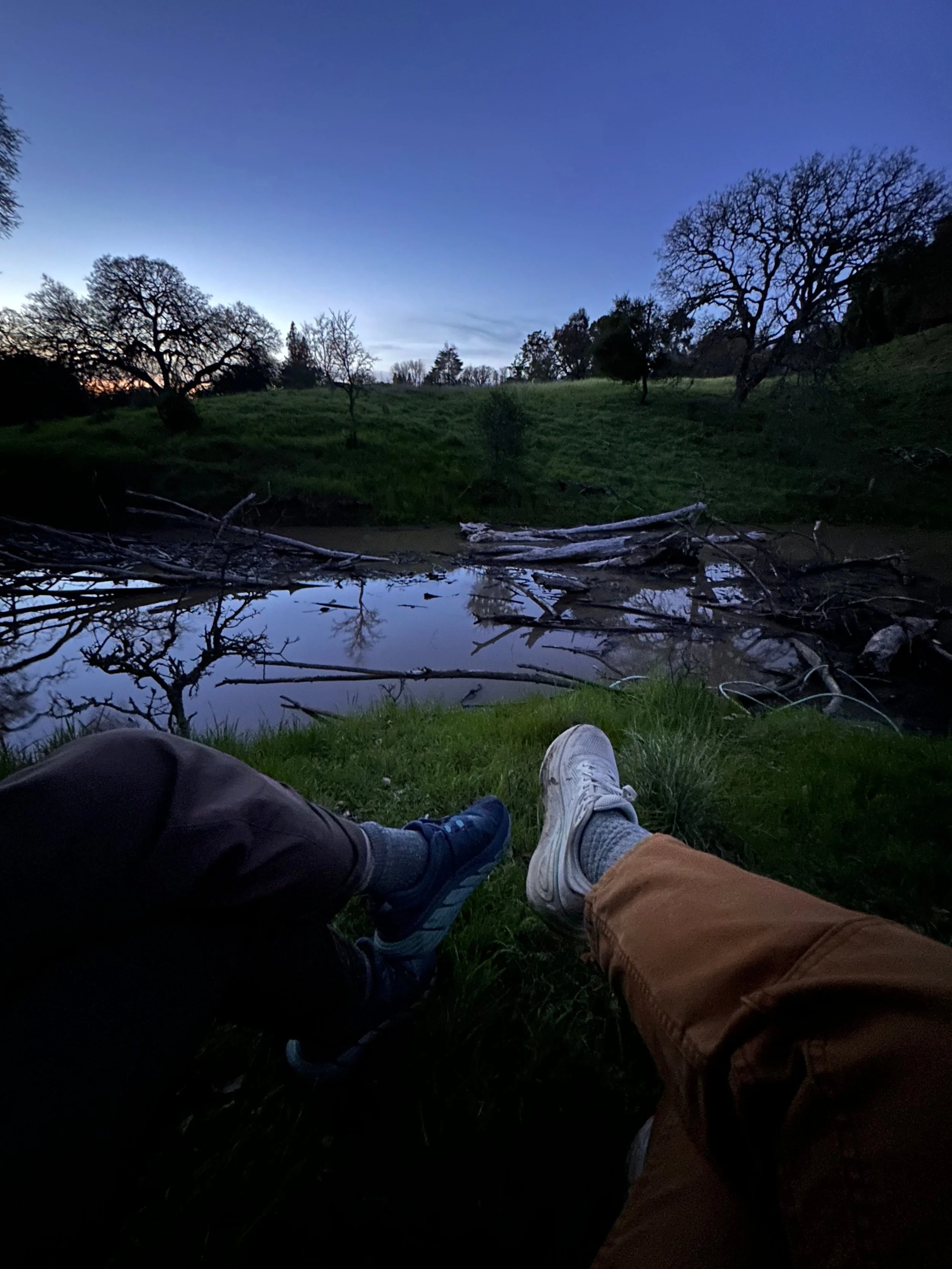
my partner and I, sitting front row at our local Frog Bog
My best essays and musings are from the trail or long drives. [5] Sometimes I will sit on a rock and write in a pocket notebook, or my commonplace book, or a sketchbook, or open voice memos and just speak. To me, the point of being a writer is to be surprised at what comes through our bodies and worldly experiences. To show others the way with the opportunity to connect through words.
For creating artworks, my mission is to make people love nature and seek the pleasure that comes from being in it. In order to do this, I bring my sketchbooks with me everywhere and most of my new paintings start there or with a direct sketch from a photo reference I took. Combining observation with a photo helps me honor both the image and the memory. I love giving myself permission in my sketchbook to try a number of different experiments to figure out exactly how I want to approach or draw something.
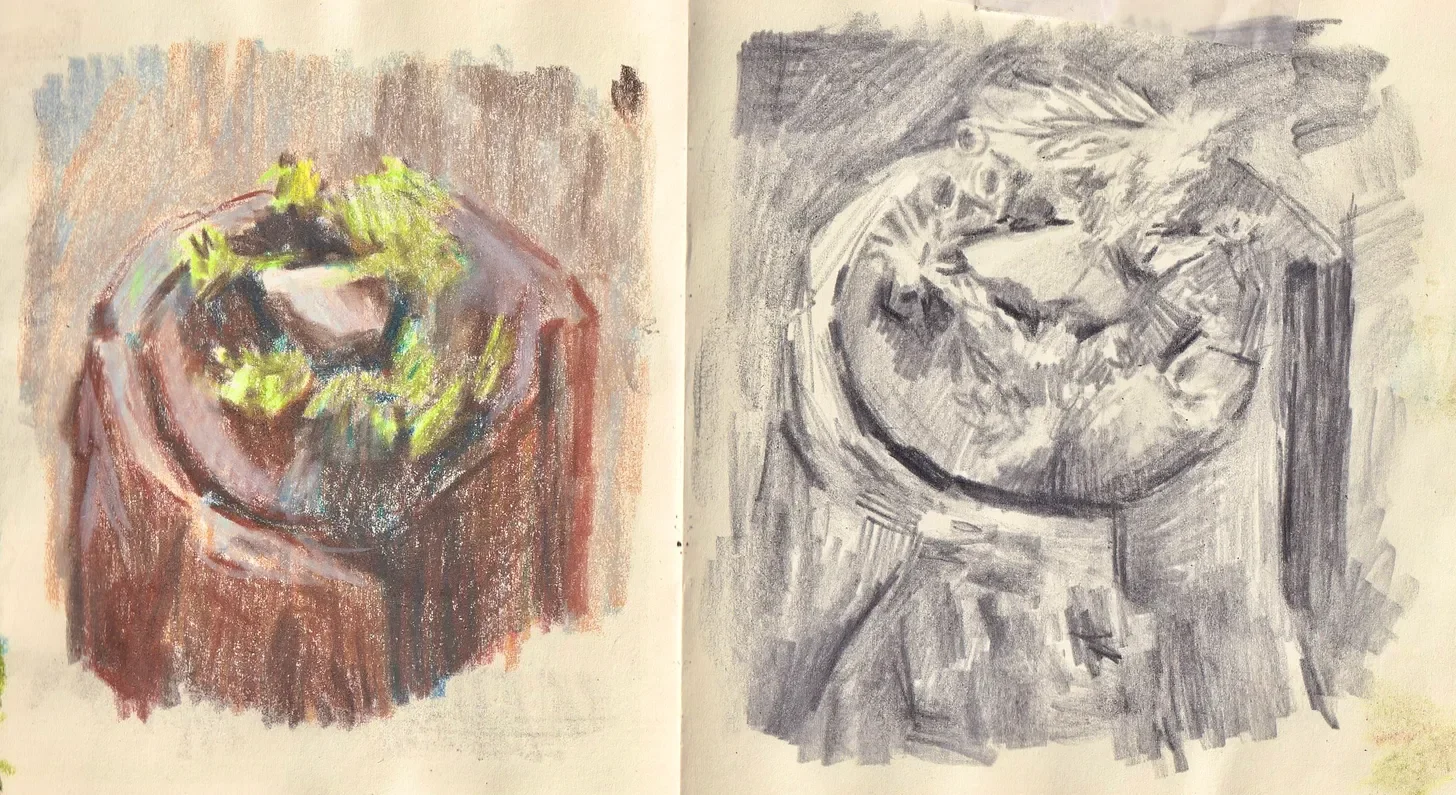
a sketchbook page of the lichen altar I setup at camp in the Sequoia National Forest
I have also found that painting in plein air has helped me overcome a lot of the burdens put on me in art school. I’m way more open now to dancing with my work and being adaptive rather than being controlling and reactive.
what painting outdoors has revealed to me
Art is a wellness practice for me. That informs the way that I teach it.
The pod-class I made last year, The Hikers Way, teaches my creative method. What being outside does in truth is that it opens up my creative and spiritual channels to intuition and curiosity without all of the shame and obligations to do other things I feel at home.[6] My AuDHD brain absolutely needs to be outside to access quiet that is only accessible when out in nature.
But being outside means that it often feels like a lot of work when too many ideas come at me. A few weeks back when I was heading on a backpacking trip, someone on the Persistent Bloom Discord was like “wow, that will be such a nice, long vacation!” but the sort-of joke is, being in nature is when I do my best work, get my biggest inspiration, and let things just come through me. It’s The Office, and on that trip I wrote the lessons for my upcoming Sketchbook Class.
I don’t want to glorify overwork though, and recognize that sometimes you will go outside and nothing will happen, or your idea cups are already filled. It’s ok to let things wash over you and not write them down. This is what practices like meditation are helpful for. I sometimes have to do this in order to stave off burnout. If ideas are meant for you, they’ll come back. Rest is part of the process too.
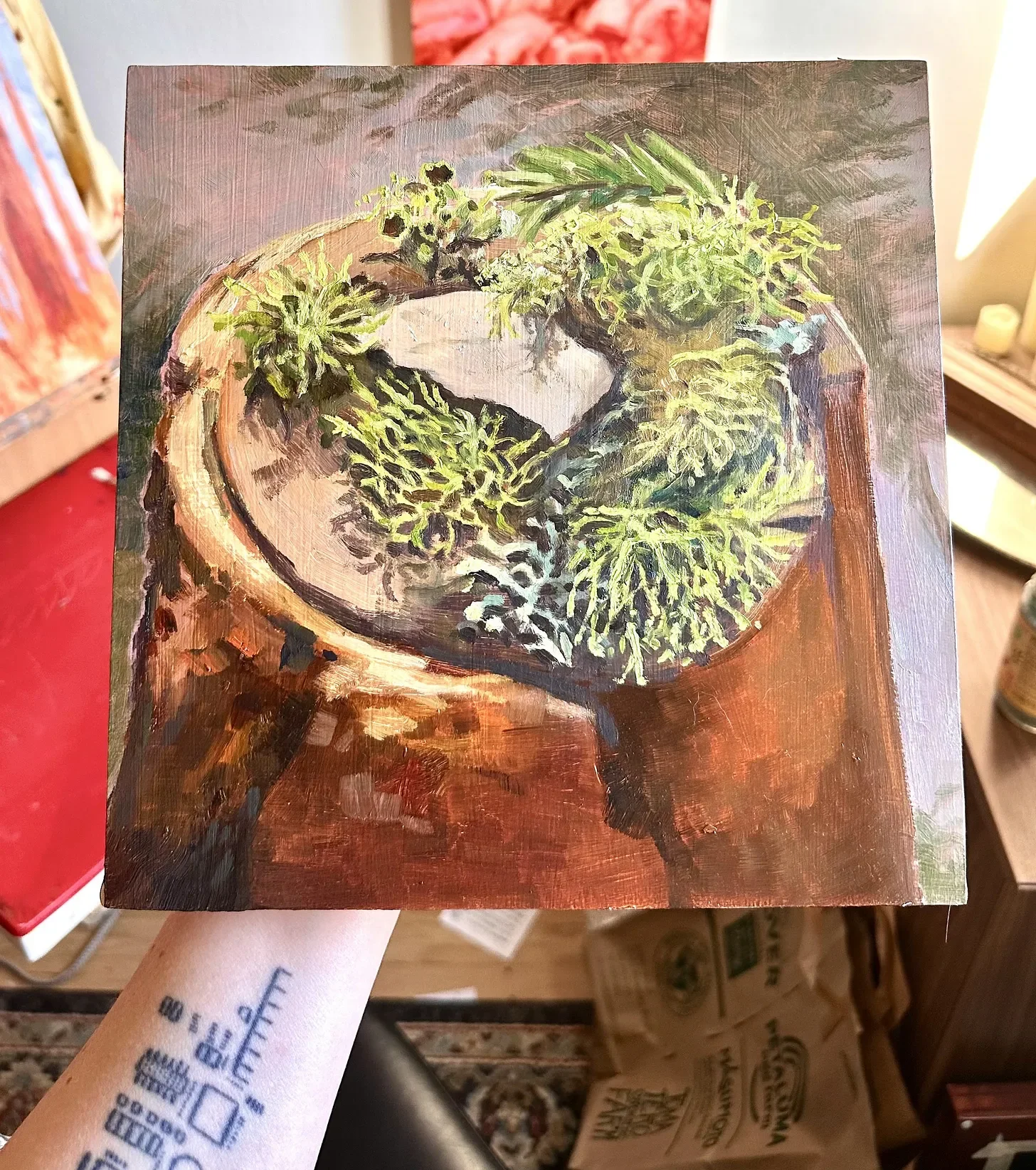
the oil painting, in progress, of the Lichen altar I made while camping in Sequoia National Forest.
What I do when I need support
When I quit Instagram last January, I had to work hard to decenter that platform as a social space and point of connection. Two of my closest friends in Kansas City that I have known since 2009 and 2010, are the folks I lean on the most. Instead of looking at each other’s stories, we now have long, meandering phone calls. Sometimes these are 3 hours or more. I cherish them.
AI removes the friction of setting up a phone call, because it is always available. This isolates us from one another. Running all of the struggles I am going through with friends and people that love and support me, is essential. It’s a reminder of how wealthy I am in relationship. I have a squad! Not everyone has this, but it is worth putting in the work to cultivate community. As a neurodivergent person I know this work can be deeply uncomfortable, but next week, I’ll be sharing a piece about the rewards of discomfort.
Because I am critical of social media as a technology, sometimes YouTube feels pointless, like a struggle where I can’t ever win. But the deepest reason I keep it up is that posting there has made me so much closer with my dad!(Hi Dad, I love you!) He’s worked in television his whole life and offers me direct, supportive, critical feedback on how to improve. He points out audio issues, weird snags in a jump cut, tells me the length of time to leave between clips. The cadence of my editing style and desire to keep going when I feel like giving up comes from my dad. Again, relationships and our community is what makes us truly rich. [7] These are the things that AI is trying to take from us.
I also have really relied on asking the Persistent Bloom Discord community for support, and looking to them as inspiration and guides for when I don’t know if something will land or if I want to pivot and try a new thing. I have immense gratitude for these folks and plan to share a very cool project I have been working on with them over the last 6 months (sketchbook zines!!) very soon.
One of the biggest things that came up for me when using AI or working with people who used it, is that LLMs offer a killswitch for our intuition. [8] Instead of pausing, waiting, and resting when needed, it invited me to a complete disconnection from my body and human brain. This is the aspect that scared me the most.
So, putting AI sobriety in action, I went through my own systems and supports that I used for years before these technologies — my commonplace books. [9] While I called these sketchbooks, from 2016-2020 I primarily wrote in them. Simple reflections and spreads I’d build myself several times a week using Tarot cards and other Oracle decks as anchors to look at the world.
I have talked about tarot and my spirituality a tiny bit here, but often shy away from it because the use of cards or occult practices can really repulse certain people. Yet when I first started putting myself out there again as an artist, I made a tarot and creativity podcast. I am debating resurrecting it.
This year, I wrote “unfollows are a gift, you are finding your people” on my manifesto for 2026. So here I am, admitting fully that when I’m lost, I setup an altar to my beloved ancestors and pull some cards. Journaling and connecting to this practice is the mycelial root of everything that I do.
Have you noticed there are not big corporate sponsors in my videos or written dispatches? That’s on purpose. I take pride in being reader supported.Consider becoming a patron here OR do one of the following:
hire me to bolster your art through craft tutoring or project support
join one of my upcoming classes
What the editing process looks like
I have mild dyslexia, so I use the basic spellcheck in Notion or Scrivner when I’m typing often. I used to use — and got a lot out of — Grammarly to check and evaluate my writing for both clarity and weird misuses of tenses, etc. But after choosing AI sobriety, I stopped using this tech and now rely on my partner’s beloved, annotated version of the Strunk & White The Elements of Style book on my writing desk. Sometimes I break the rules. My writing is always evolving, and I love the growth I am able to see in my own work as it changes.
For each article or video script I write, I read it aloud, twice. Catching when things don’t fit into my authentic tone or voice. Then I ask my spouse to read my bigger articles before I post or go to film.
I will still catch errors in my writing and missteps in what I was trying to convey later, but I don’t really care! This is all part of me embracing that this is my feral era, baby!
Typos and tense mistakes are humbling and cute now. English is hard! More than ever, I think perfectionism is a way we internalize the control and surveillance of our capitalist culture to be a good little worker with perfect little pieces of writing. I would rather fail in public and stay human.
Copywriting and building solid quippy ideas for YouTube titles & thumbnails or text on my website is always a work in progress. Sometimes things hit, sometimes things flop. But I always prefer my human writing to the output of an LLM, because it will reach the right people. I simply have to keep showing up and ignoring the stats.
My tech stack
My website is run on Squarespace, and yikes they have put their little sparkly AI button offer into everything but I just ignore it. Their customer service team has been genuinely helpful and I really like building my website there. [10] I have been using the service since 2016, so it is a really meaningful archive of my work past and present. My website is searchable by AI now. I learned that the little opt-out buttons just make us invisible to search engines now, while the LLMs still take what they want and that sucks.
For notes and task management I still use Notion for basically everything. It’s where I plan my whole life. I have several databases where I plan out video ideas, newsletter dispatches (like this one), and track tasks. My partner and I use a family dashboard. I love being able to make a space that feels aesthetically pleasing, while reminding me of why I do what I do. This is also how I manage tasks for my varying energy levels to maintain a compassionate expectation of myself. It is easy to get overwhelmed with my unique quilt of neurodivergence, Notion dashboards I hand-build are key for avoiding this.
But Notion uses AI! All the billboards say they have agents! Yep! I just emailed their support team, and asked them to remove the AI features and they did. They were so nice about it! Now I have 2021 Notion back and it is amazing, I fully recommend you do this, and I want the option to turn AI off in every app!
My main space for coming up with ideas is Voice Memos on an iPhone. So I do use the on-device machine-learning there because it is private and none of my data is being shared with a large surveillance company. On the topic of my phone though, I turned off Apple Intelligence on every device I have. Again, I love the option to opt out.
I use Zoom for all of my meetings and that software loves to tout and point to AI features, but the only thing I use is closed-captioning for accessibility in my classes. Their product is a gathering space for me and other humans, nothing else.
Clients book meetings with me using my Calendly link. But this is connected to my Google Workspace because I haven’t had the time or the spoons to fully divest from Calendar, Drive, and Gmail. Because I post my ideas to YouTube, I often wonder if this is futile…
I use a human-centered offline tech tool called Obsidian for tracking research, media commentary, and mind-mapping as an alternative to generative “assistants.” But I’ll admit, this app takes a fuck-load of work and maintenance. Most of my scratch ideas go in the Notes App and twice a month I spend an afternoon sorting them into Notion and Obsidian if they have a “job.” If they were just chaotic feral musings, I let them go! Computer maintenance work is a big headache, but to quote my fav author, adrienne maree brown, the act of sorting our digital stuff and ideas is a way to access our creative abundance. [11]
I still post things on Youtube and Substack, both platforms utilize recommendation algorithms which are a type of AI technically but I try to take a harm reduction approach, to quote Amelia in her tech stack episode of Off The Grid. I no longer evangelize these platforms to others [12] and most importantly, I do not evaluate my work based on the metrics the platforms set. I do not care if my video is performing well for the platform, or if my writing is most optimized to get clicks.
I am not interested in working in a way that values engagement over my energy capacity. I no longer argue with people in Notes, I use the block button with abandon (not sorry.) and evaluate the things I put out in the world using a qualitative checklist that looks like this:
You made a social media thing! Here’s how to evaluate it:
Did you make something in alignment with your values?
Did your work connect you with at least one new person?
Did this help you show your work? (in the math-class-long-division sense, showing the art, the process, the actions you took)
Did you enjoy the process and/or did you learn something from making this?
I will then add screenshots or copy the text of nice comments or emails I get that show this effort is reaching the right people to grow my community. That way if whatever I made “flops” by the platform’s standards, I can move on and not ruminate. I have RSD, and depression. These stats dashboards will make me deeply spiral into some of the worst self-talk imaginable. They are only benefiting the corporations, not us!
Typically if I post something, anything online, my mantra is post-and-ghost. I am heading to a yarn crawl with a beloved friend right after this goes live!
I hope these insights help you work through your own relationship to AI, LLMs, Dystopian Social Media Algorithm Stat Dashboards and maybe even inspire you to write an AI policy like mine.
But again, I am not a cop or a fascist, so I don’t expect perfect “AI sobriety” from everyone. What I want is for us to be incredibly mindful of how the tech tools we use shape our worldview and the work we make. We have to remember that the dashboards and metrics they give us are in service of the oligarchy, not our intuition, or our work. They see our “content” as products that they rate in terms of how long they keep someone typing, watching, interacting, and scrolling.
I’ll end this dispatch the same way I ended the AI policy on my website, with this beautiful clip from Mr. Rogers that sums up everything I feel about AI.
& Until next time, stay creative and find your own ways to persistently bloom.
Want some support connecting with your human creative force? I’d love to guide you back to seeds of inspiration free from harmful tech. In a creative retreat we can work together to find systems and practices that will root you back into your inner artist.
it’s 2026 and the hype machine is real so I want to clarify that I’m talking about LLMs specifically. “AI” has been turned into a catch all term for all machine learning tasks thanks to clever marketing. It is truly impossible to not use some form of “AI” which is why I feel compelled to make this post and be transparent. Features I have used for decades like content-aware fill and spot healing in Photoshop, text-to-speech, any translation app, and every social media algorithm is technically “AI”
yeah, embarrassing i know, I’m not pure in this argument, I used these tools in the past and that is why my critiques are so spicy
these tech ceos are saying the quiet part out loud now.
I’m currently thinking about the way the grass looked this morning in the dawn light
winding mountain roads only, i hate being on the freeway, it stresses me out, and prefer scenic routes where i feel a deep connection between the road, the car, and my body.
of course i could organize that one section of the closet or fix that thing)
i recognize there is a privilege in this and do not take the relationships i have for granted!
and then they have the audacity to make a snide fucking remark like “your intuition isn’t wrong” ugh, gross
i talked about and toured these in my most recent youtube video
yeah buddy, i built that site all by myself, you can hire me, a human, if you want help with yours! also, i recognize that Squarespace uses AWS. I don’t know of any easy to use web dev tools that allow me to make a website that folks with low vision can access that does not use AWS. Accessibility is a central point for me.
you should listen to all episodes of the Fractal series!
you will never catch me writing content about writing well optimized content for social media because the system is pretty enshittified, they are just tools, not saviors. I am mad at these tools and frustrated with them more often than not, so please do not seek me out as a guru, im kinda there out of spite.
