how to infuse more art into the beauty that summer offers
First, and foremost I want to say hello and welcome to the folks who joined this newsletter in the past week. I am stunned by how many of you positively reacted to my little poster I made for the new art supply store in my area! Some of you, are local folks, some of y’all are just here because substack’s social media, notes, currently recommends artists. For all of you, I am grateful!
This is my usual end-of-the-month creative prompt post to help you persistently bloom in your craft.
With these dispatches, I suggest taking them into your studio, journal, craft group, mending night, or any place you like to create. Sit with them. You can shape them into works, poems, journal entries, or just yap into voice memos to find clarity through them.
I’d like to share this album of my best images from 2025 with everyone this month as a genuine thank you for being here in a place where I can reliably reach you. I appreciate you inviting me into your inbox.
I share bonus and expanded versions of these posts, alongside albums of photos I’ve taken on hikes throughout the month, with paid subscribers. These are for folks to use as references for drawings, poems, paintings, indie video game environments, but never for use with AI.
One last thing on the topic of summer, next week, Sunday, June 7th at 10:00 AM PST I will be teaching a GO BAG CLASS inspired by the Go Bag Zine I made last year! This class is for anyone who has meant to make a grab-and-go bag, but hasn’t. We’re gonna do it together in real time! I’m offering this one with sliding-scale pricing!
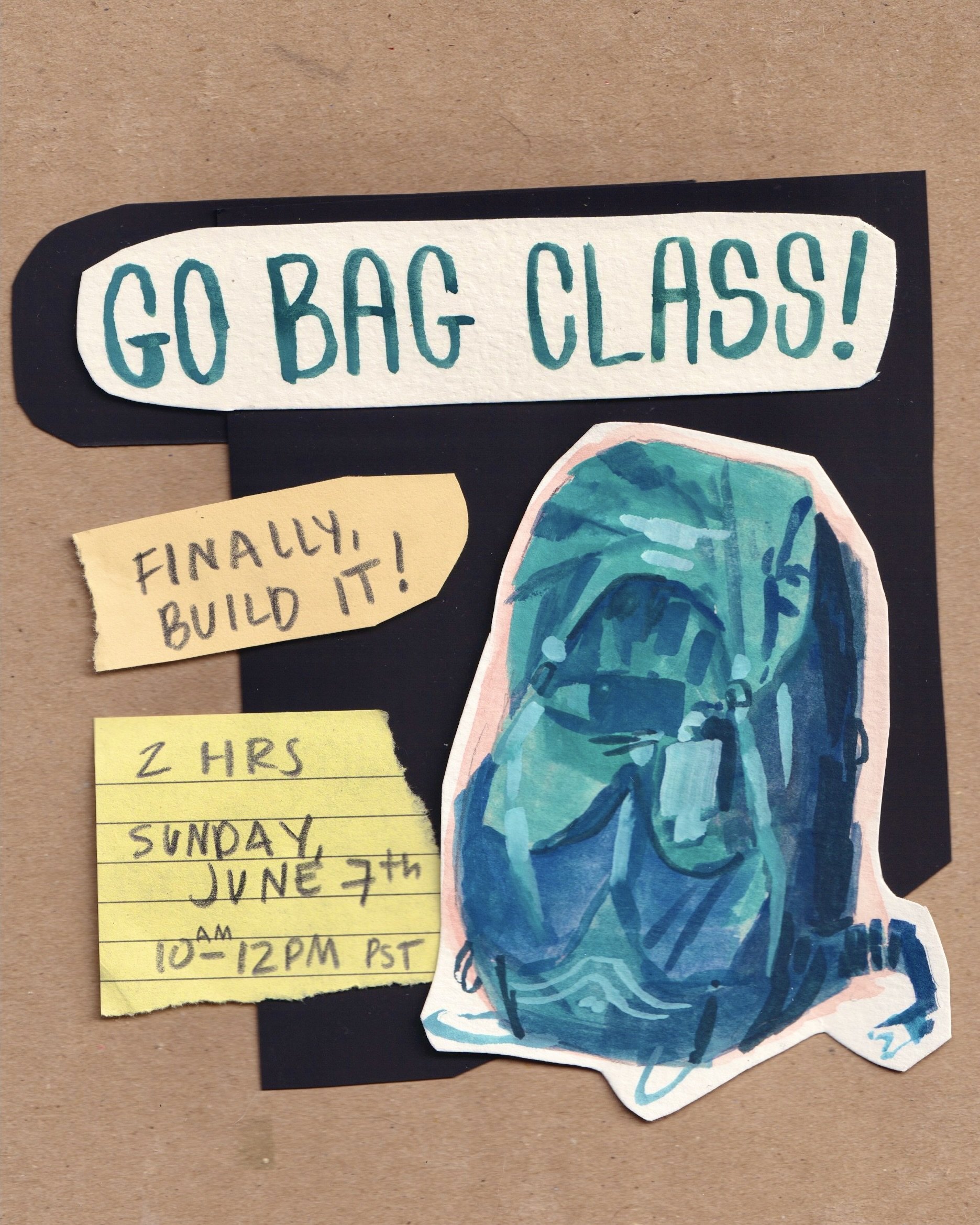
my collaged flyer for the Go Bag class next weekend on June 7th from 10-12 PST
I’ll send you a list to gather before class, then we will build our bags (or wagons!) step-by-step! We will discuss where to store them and you can ask me and my spouse — two experienced campers and backpackers — questions about gear, food and more. We’ll also talk through practicing for when something happens.
This class is inspired by the wonderful book, Parable of the Sower by Octavia E. Butler. With the “super el niño” on the way next year, and wildfire season just beginning, the best time to have a Go Bag and a plan with your family and community is today.
Now, let’s get into the post.
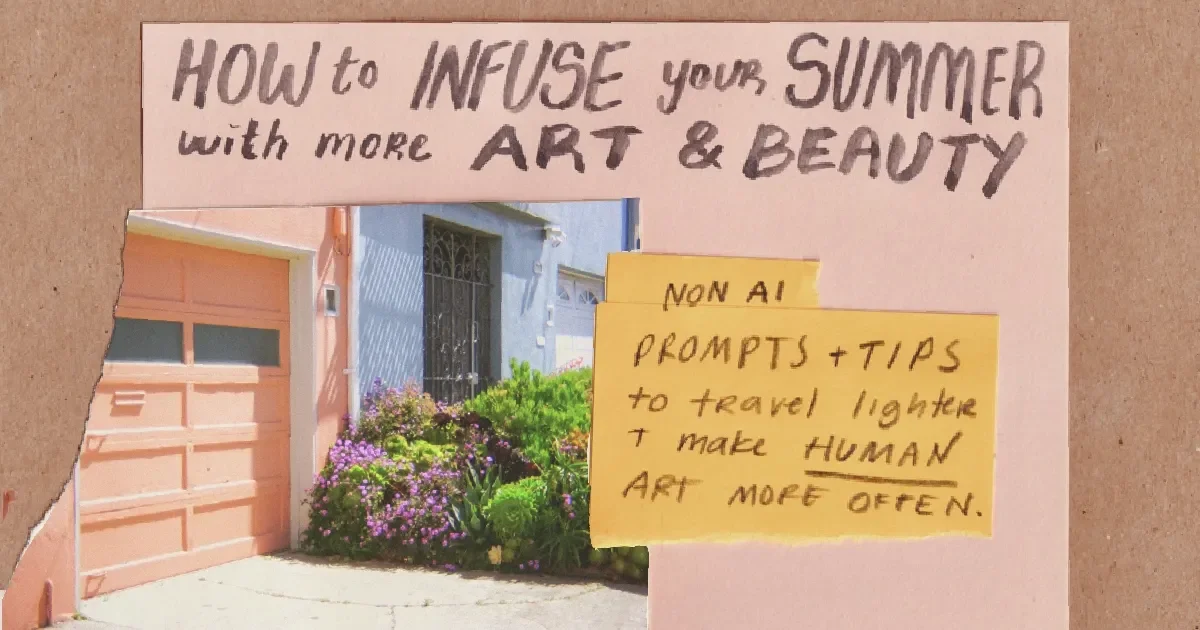
a collage I made for this post using physical materials, procreate, and a photo I shot on my camera when walking around San Francisco.
Next week is June, and that threshold represents that Summer is almost here. This time is usually filled with camping trips, outdoor meetups, hiking trails, time at the beach, picnics, and lots of time spent in the sun. I want to help you make the most out of your summer by considering your art as a vital part of how you spend your long, savor-able days.
I believe that art making is a wellness practice, one designed to support your well-being. It can be quiet and private. It doesn’t have to look like producing a masterpiece worth sharing on social media or turning any of your art into a product. The following experiments will help reveal more of the play that your soul is craving.
1. Connect to your body first.
When I was in art school, I was unfortunately taught to ignore my body and spend as much time working in the studio as I could. 14 hour drawing marathons that my mentor normalized led to a repetitive stress injury in my drawing hand that still flares up today. We must start with the body to avoid this as we must care for the tools we use for our art.
If I sit or stand at my desk all day, my connection to my body is severed. I hyper-focus when working on client projects or editing an essay I’m working on. I become completely unaware of the pain or discomfort that is forming beneath the surface until it’s too late. Since last March, I have been healing from a spinal injury — one that was severe enough to prevent me from walking or driving for a large swath of last year. This is now something I live with and must listen to or feel the wrath of movement debt.
Often when I tell folks I make some of my best art outside, the very idea sounds excruciatingly uncomfortable. In the summertime, heat permeates everywhere and it is hard to tell how hot it really is until you’ve got your mini-studio setup and start working in the sun. Tuning in to my body first reminds me that I need a baseball cap, a breezy shirt, sunscreen, a camp chair with lumbar support, shoes that don’t pinch or hurt, and plenty of water.
When we have strong roots, and our bodies feel supported, we can make room for inviting the gentle discomfort of making our art.1Our body is a resource that can tell us what is out of balance, where we are feeling pain and tightness and where we might loosen up if we just listen. Simple practices of body-scans or stretching help protect your tools and help prevent injuries.
Physical maintenance rituals and check-ins with ourselves don’t seem useful to the creative practice. We aren’t producing! Yet most of my repetitive stress injuries from drawing or knitting could have been prevented with proper ergonomics, check-ins, and adaptations. Maintenance is a vital part of the work. Just like practicing your scales on an instrument or doing a drawing warm up, moving your body even the smallest amount, can help you sense your tenderness and know how to adapt today.
The over-culture makes this so hard. We aren’t taught how to do this in a way that supports us gently. I spent ten years being a willing participant in luxury surveillance by wearing a smartwatch and letting its algorithm tell me how much I needed to be working out, how hard, and in what way. Now after more than a year away from those dashboards haunting me, I know exercise functions as simple maintenance work for my body.
Questions to ask of your body:
Is there pain I’m sensing today? How can I support this pain with what I have planned or what I want to make?
What would make me feel most comfortable?
How can I setup my supplies in a way that supports my body? Do I need to sit at a picnic table vs. on the floor? Could a camping chair help?
Can I incorporate movement into the practice of making my art?
What do I need to feel nourished? A thermos of tea or soup on a mountain pass, or some sparkling waters in the cooler in the trunk of my car? Electrolytes to stay hydrated in the heat?
2. Pack way lighter than you think
Remember packing for a slumber party as a kid? There was this impulse to bring everything you could to maximize the potential for fun. This is honestly how I used to pack for a hike, but after you lug too many supplies uphill for a few miles once, you’ll be reluctant to do it again. Let lightness be your guide!
I have made and remade, and remade my adventure art kit. The most important part is the weight of my kit. The lighter, the better. My inner slumber partier wants to have the biggest selection for my creative whims, and I have to ignore that impulse. We often carry more than we need and this can lead to discomfort or worse, injury. Making any kind of art outdoors requires simplicity and constraints.
For me that sometimes looks like just bringing a pen and a pocket notebook, other times I’ll bring my sketchbook with a water soluble pencil and a brush. Over time as I have brought more and more things, I return from a trip and take inventory: what did I use? What made me avoid the things I didn’t use? What made these supplies inappropriate for this kind of trip?
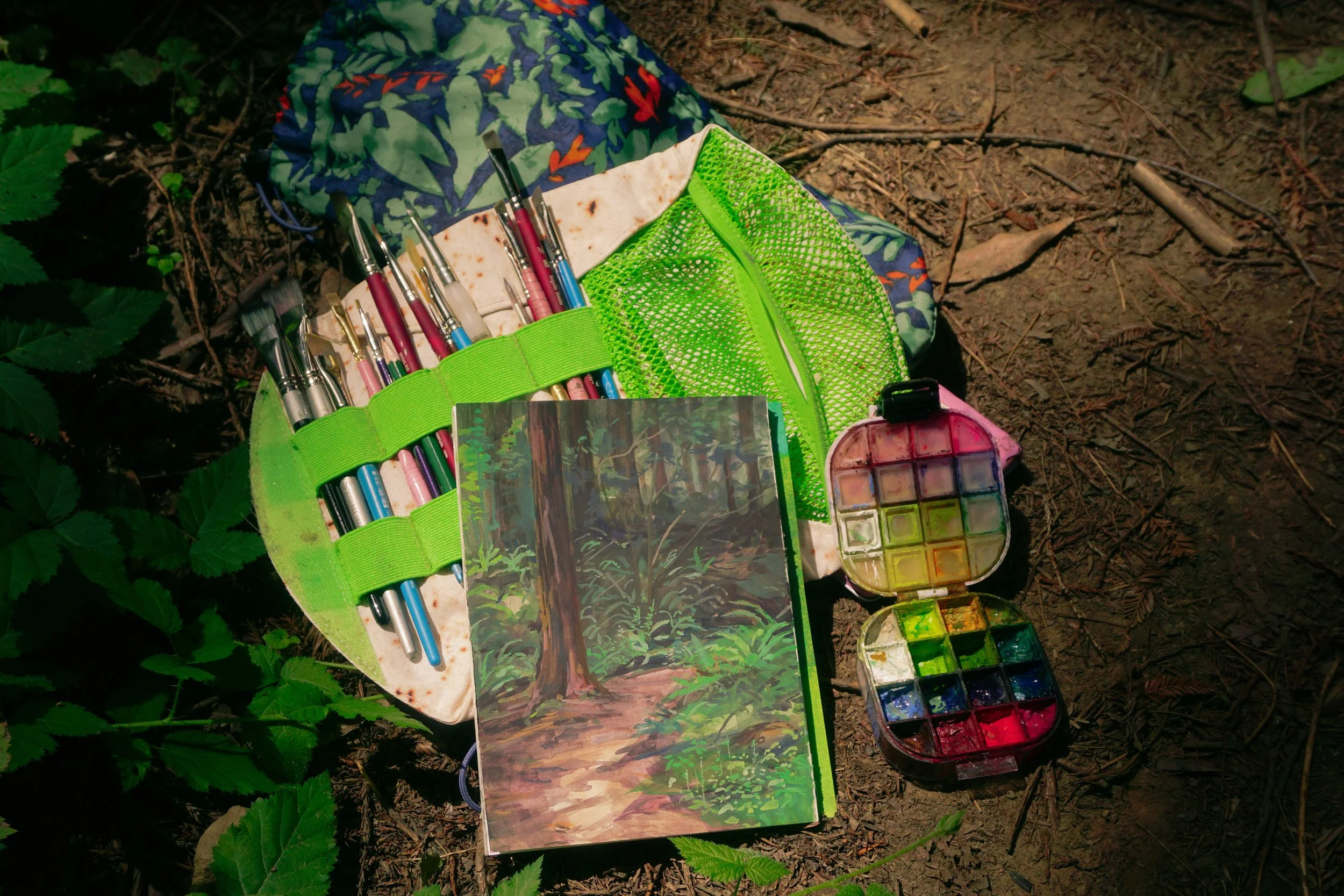
a photo of my usual adventure art kit sitting among the blackberry vines on a redwood trail in Oakland, CA
Some simple questions to ask when deciding on supplies:
What do I want to try and capture on this adventure? Is there something in particular I am interested in observing at this time?
Is this supply new, or something I have used for years? How do I prepare myself to use it on an adventure?
Do I like the particular marks, sounds, or feel of this supply?
Have I test-driven this kit — bringing it out with me on a walk to a local park or garden— to see what I use and rely on?
Is there a lighter or more versatile version of a heavier thing I planned to use? For example, I have totally fallen in love with water-soluble graphite crayons this year and those little brushes that can hold water instead of my full gouache kit and easel.
Technology can also be a helper here, revealing that our phones can be partners rather than thieves. I love recording into Voice Memos or scrawling into the Notes app while sitting on a rock outside. Being in nature usually limits our access to cellular service, making our devices into no more than cameras/ pocket typewriters.
This is why I think nature time feels so good to us in an era where we always have the ability to scroll at our fingertips. Last summer, I bricked my iPhone using an existing accessibility setting — instead of buying a Light Phone or other devices — and was pretty pleased with the results. You should try this yourself if you are feeling the pull to scroll while preparing to travel.
In terms of packing lightly, the thing I turn to lately is bringing my old digital camera out with a vintage lens on it. This lets me focus on composition and capturing references and nothing more.
You will be surprised that by spending time outside tending to your imagination, a huge wave of ideas will come over you like a snowmelt river. All you need is the bare minimum required to capture those ideas or those inspirations. Want some support with cultivating this?Check out my Pod-Class The Hikers Way which is on sale for $99!
3. Invite kids in your life to join
Whenever I really feel stuck creatively, I think about my time spent in the classroom supporting the art of children. Working with kiddos shows you the imaginative parts of ourselves that we have hidden under years of unwelcome feedback, bad advice, and cultural conditioning that makes the arts into a minor character in our lives. Kids are constantly creative.
A few months ago when hiking on a trail, my spouse and I were pointing out the neon orange color of some fungus we were photographing to a family that walked by. The young kiddo with them ,who looked about 7, immediately recognized me as an adult who still notices with wonder and asked:
“Um, have you seen any Banana Slugs? I haven’t found any!”
I had seen some slugs, but their color was oddly dark, a muddy yellow. I knew from my experience in the classroom, this kid had likely painted recently and would know exactly how to find them when I explained the color to look for.
“Yes! But, the slugs today look a little different, have you ever mixed a little black paint into yellow paint? You know how it becomes a muddy green color? Look for that!”
This kid nodded in excitement and certainty. Painting and mixing color fostered an immediate understanding of exactlywhat to look for. The parents thanked me for the info and they walked on up the trail, knowing their little was about to find some Banana Slugs.
Instead of thinking about your art practice as sitting in a studio having a rigid routine and following all of the productivity advice that you’ve gotten over the years, act like a kid. Be wild and free and embrace impermanence. When you see a kid making a sandcastle on the beach, they know and you know that it is impermanent. The tide is going to come in and completely wash it away, but the fun of doing it is not diminished by this fact.
Questions to ask and a game to play with adults and kids in your life:
What would it mean to allow yourself to make things that are impermanent?
Could you have a goal or a special notebook that you show to no-one and you allow yourself permission to play in?
When was the last time you tried to emulate something you love? The act of studying another artist’s work is something we tend to brush off as plagiarism, but kids make fan art all the time. What can we learn from artists who have done the work we’d love to make?
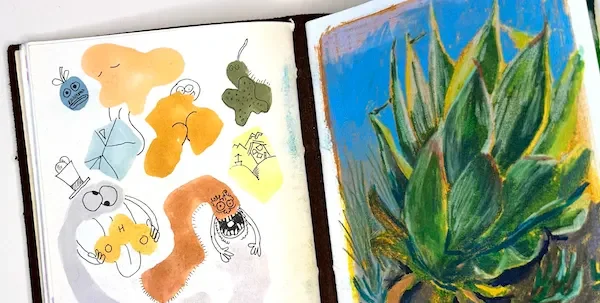
an example of The Blob Game played with my spouse. I drew the shapes, he added the details with pen!
The Blob Game
Grab a piece of paper, a light-colored marker, and a darker color in either a pen, crayon, or color pencil.
Step 1: Use your markers to draw whimsical blobby shapes
Step 2: Pass this paper to someone else and ask them to decide what the blobs look like and respond. Are they slugs, worms, berries, dragons, or gemstones?
Once you decide what these blobs are, draw on the marker shapes. Add eyes and faces. Be silly and unserious!
Continue to trade off, and if there are more people sitting around, do step 2 with multiple people on each sheet of marker blobs.
This game is best played with adults, especially those who can “only draw a stick figure,” or with kids over the age of 5. Younger littles can still have a lot of fun making the blobs and imagining what they look like, but might need a little extra support with step 2.
4. Stay gentle on yourself
I want to remind you stay really soft on yourself as a person this summer. We are inundated with images and stories from horrible atrocities done with our tax money (if you’re in the U.S. like me) and it is getting harder and harder to simply survive. The way you are able to make this summer is absolutely enough. By focusing on limits or rules, taking as many rigid expectations off your plate as possible, you’ll be open to the shape your work takes.
I am so often pushing myself to perform at this extremely high-level because I’m a rising Capricorn, an art educator, and because I’m writing about/teaching creativity online. I feel like I have something to prove so I always say yes to doing too much!
Last year when I was car camping in Sequoia National Park I was hard on myself. I brought my camera, oil paint, my gouache kit, my guitar, midi controller, and laptop so I could keep making after we lost sunlight. On that trip, I made one painting I loved and ended up writing more than anything else. This unexpected practice required only my phone as a supply and led to some of my most resonant essays last year, like the one on my AI sobriety.
Journal prompts to stay gentle:
Am I trying to prove something to myself or others by doing this specific thing while on this trip?
Regardless of what I brought along or have planned, what am I sensing into doing the most in this moment?
Can I spend a bit of time reflecting on what I was able to accomplish on this trip/session/hike? Writing a simple did list can help, especially if you are taking note of the supplies and the time it took to do each part of the work.
End of email magic announcements:
I’m running an almost-summer sale on all class recordings on my website through the solstice.You can check all of those out here. 🌞
A bunch of my online small business pals and I are running a mutual-aid fundraiser in support of our friend Loopy’s surgery recovery. There a whole bunch of discounted digital offers and services you can snag before it ends this weekend!
If you’d like to support my work and become a patron of my practice, you can hire me to support your art or projects, you can shift your subscription to paid on Substack using the magic button below, by buying me a coffee, or by joining my new Patreon at any level that suits what you can contribute.
Below the paywall, this post continues for paid subscribers with a photo library link and additional tips regarding stillness and time for integration. If you can’t afford to be a paid subscriber right now and want some more simple non-ai creative prompts to support your art check out these posts from the archive:
